Spacewar!
Содержание:
Running SPACE WAR
The SPACE WAR program make use of the IOX-11 package for teletype IO, which means that this has to be loaded before the SPACE WAR program. Since the IOX package make use of the IOT instruction for all operations there is no linking needed. But the address of the IOX package has to not collide with the SPACE WAR program itself address space wise. It appears that the IOX-11 pacakge is fixed at 015100. There are no instruction on how to assemble the package and a try in PAL-11S results in 245 errors. The IOX-11 package is an absolute binary and is loaded by the abolute loader as most other programs.
So why is it halting? There is a Non existing memory (NXM) handler installed by the IOX-11 package.
Location 4 is the NXM trap handler and the handler is located at address 15604. Then there are handlers for the paper taper reader, the tty keybaord and printer etc.
A breakpoint in SimH at that address show that the SP is pointing to
Now checking the stack at this SP value:
So the Stack contain the PC of the next instruction after the one causing the NXM trap.
So the offending instruction is the one at 34624 which is trying to reference the ADCS register at address 176770. And since this device is not implemented in SimH this address will not respond and thus the NXM trap!
The code at 15604 will subsequently make a JMP to address 40 where the HALT instruction is executed. Thus stopping the processor.
Then when I had installed the correct hardware and patched the source to use AR11 it still failed. Then I discovered that the stackpointer is initialized with the SPCWAR symbol. Meaning that it grows downwards from that point. Not having the SPCWAR module as the first module will then be a problem since the stack will overwrite the code. I.e. The SPCWAR module has to be the first module and the POINT module has to be that last module. Otherwise the order is of no importance.
О слоте
Начиная играть в игровой автомат Space Wars бесплатно и без регистрации, гемблер перемещается в космосмическое пространство. Здесь он знакомится с жителями других планет, которые сражаются друг с другом за обладание кристаллом. Действие разворачивается на поле из 5 барабанов с 4 рядами символов. Призовые комбинации можно собирать на 40 линиях выплат.
Настроить количество линий нельзя, зато можно изменить стоимость монеты в диапазоне от 0,01 до 0,5. Уровень ставки также изменяется с 1 до 10 монет на линию. Таким образом максимальная стоимость вращения составляет 200 кредитов в валюте онлайн-казино.
Игровое поле
Оплата призовых комбинаций происходит слева направо от крайнего левого барабана. Минимальное количество символов в последовательности — три штуки. Процент возврата (RTP) заявлен на уровне 96,75%. Прогрессивного джекпота в автомате нет, но максимальный выигрыш в 200 000 кредитов при игре по-крупному вполне способен его заменить.
Steve Russell — Inventing of Spacewar
It was in 1962 when a young computer programmer from MIT named Steve Russell, fueled with inspiration from the writings of E. E. «Doc» Smith, led the team that created the first popular computer game. Starwar was almost the first computer game ever written. However, there were at least two far-lesser-known predecessors: OXO (1952) and Tennis for Two (1958).
It took the team about 200 man-hours to write the first version of Spacewar. Russell wrote Spacewar on a PDP-1, an early DEC (Digital Equipment Corporation) interactive mini computer which used a cathode-ray tube type display and keyboard input. The computer was donated to MIT from DEC, who hoped MIT’s think tank would be able to do something remarkable with their product. A computer game called Spacewar was the last thing DEC expected but they later provided the game as a diagnostic program for their customers. Russell never profited from Spacewars.
Joysticks
This is basically almost only parts ordered from Aliexpress.
- Cable bending protection.
Each cable going from the connector has +5V, GND and Angle and Acceleration. I used a cable with three pairs and individual sheilding for each pair. The pairs are:
- +5V and GND
- Accleration and GND
- Angle and GND.
The fire button is connected to short circuit the acceleration potentiometer to the 5V supply. It is importtant to use a joystick typ that is not full range. The M1 model goes from 1.8k to 3.6k. Thus short-circuiting the viper to 5V when at the lowest position of the viper in the joystick is not a problem. The Model M1 linked to above is this non-full range type. However if you choose model M2 you get into trouble. Then you could add a resistor, maybe 1k or 2k in each end of the potentiometer to avaoid short-circuitng the 5V to ground. So be careful when selecting the joystick.
Description
The PDP-1’s operating system was the first to allow multiple users to share the computer simultaneously. This was perfect for playing Spacewar, which was a two-player game involving warring spaceships firing photon torpedoes. Each player could maneuver a spaceship and score by firing missiles at his opponent while avoiding the gravitational pull of the sun.
Try playing a replica of the computer game for yourselves. It still holds today up as a great way to waste a few hours. By the mid-sixties, when computer time was still very expensive, Spacewar could be found on nearly every research computer in the country.
Cable harness
I used 47217-000LF/48254-000LF contact elements and 65043-015LF contact housings. The cable is a three pair shieled cable for the Joysticks and the X, Y and Z inputs. An extra cable of simpler type was used for the intensify signal in case I ever wanted to use it.
| Pin | Signal | Connect to |
|---|---|---|
| A | WRITH THRU L | NC |
| B | DISP CH02 L | NC |
| C | ERASE L | Pull up to 5V in the scope end + Z input of scope |
| D | INTESIFY | Optional Z input if the standard point plotting mechanism of the AR11 is to be used for other purposes. |
| E | NON-STORE L | NC |
| F | X OUT | Scope X input |
| H | ERASE RET L | NC |
| J | Y OUT | Scope Y input |
| K | Analog ground | ground for X and Y twisted pair. Including shield |
| L | A/D CH 17 input | NC |
| M | Analog ground | NC |
| N | A/D CH 16 input | NC |
| P | Logic ground | Z — axis pair ground and sheild |
| R | A/D CH 15 input | NC |
| S | Logic ground | Intensify Z- axis pair return and shield (optional) |
| T | A/D CH 14 input | NC |
| U | EXT AD ST L | NC |
| V | A/D CH 13 input | NC |
| W | Analog ground | NC |
| X | A/D CH 12 input | NC |
| Y | Analog ground | NC |
| Z | A/D CH 11 input | NC |
| AA | Analog ground | NC |
| BB | A/D CH 10 input | NC |
| CC | Analog ground | NC |
| DD | A/D CH 7 input | NC |
| EE | Analog ground | Joystick 2 Acceleration pot ground and shield |
| FF | A/D CH 6 input | NC |
| HH | Analog ground | Joystick 2 Angle pot ground and shield |
| JJ | A/D CH 5 input | NC |
| KK | Analog ground | Joystick 1 Acceleration pot ground and shield |
| LL | A/D CH 4 input | NC |
| MM | Analog ground | Joystick 1 Angle pot ground and shield |
| NN | A/D CH 3 input | Joystick 2 Acceleration pot viper |
| PP | -14V HQ | NC |
| RR | A/D CH 2 input | Joystick 2 Angle pot viper |
| SS | +14V HQ | NC |
| TT | A/D CH 1 input | Joystick 1 Acceleration pot viper |
| UU | +5V output | Power to feed joysticks and pull-up resistor for Z-axis |
| VV | A/D CH 0 input | Joystick 1 Angle pot viper |
Gameplay
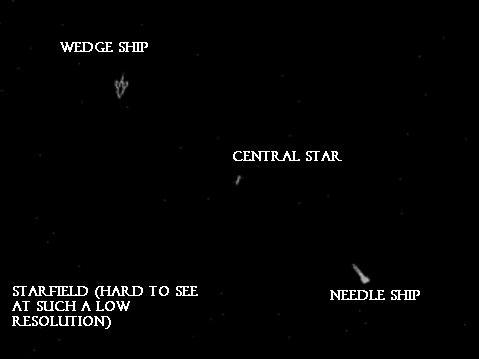 A modern play test through a working PDP-1
In the basic game, two players are pitted against each other in a duel. Each control a spaceship; one wedge shaped, one cigar shaped, which are destroyed if they run into any other object in the game.
Each ship has a limited number of torpedoes to fire at the other from the front of the craft, adding to the current speed of the craft, with a hit killing the target. These torpedoes have proximity fuses which would detonate if the torpedo gets too close to another object, including other torpedoes, eliminating the need for coding collision detection for them. The ships rotate about their center, and have thrusters, with limited fuel reserves, to propel forward. Initially, a random star field was added, because players needed to gauge their relative speed and position to try to be able to hit their opponent.
To help add variety to the battles, a hyperspace ability was added by Graetz, which allows ships to blink out of existence and reappear randomly elsewhere in the playing field; a mechanic used in later games such as Asteroids. Each time hyperspace is used, there is a chance that the ship will explode by coming too close to other objects. If hyperspace is used during a duel, the ship will automatically explode, to prevent player abuse of the feature. Finally, at the center of the playing area is a flickering star with gravitational influence upon the two ships, accelerating them slowly toward the center.
Rotate, thrust/hyperspace, fire
One notable addition is Peter Samson’s star field (dubbed Expensive Planetarium, the term expensive being a joke referring to how much the machine itself had cost). This star field was is accurate representation of the night’s sky, in contrast to the random star field coded by Russell. Samson’s star field slowly rotates as the game progresses, giving players a full view of the actual position of stars over time. This did not add to game play as such, but it did show off the processing power of this machine to contemporaries.
Other options were added and features changed. These included toggle switches that altered gameplay: the central star’s gravity could be switched on and off, the existence of angular momentum could be removed, the star field could be switched off, and a «winds of space» feature could be added which pushed spaceships in one direction, forcing players to use more thrust to go in certain directions and causing drift.
Players originally played the game using the debugging switches on the machine, but these quickly wore out, so controllers were built from scratch. These are the predecessors to modern video game joysticks.
Игры, которые вдохновил Spacewar!
На протяжении многих лет, многие компьютерные игры были вдохновлены игрой Spacewar!; некоторые из них известны под тем же названием. Некоторые из них просто клоны, а в большинство из них были введены дополнительные варианты игры, такие как:
- разные темпы ускорения
- различные уровни гравитации (даже отрицательные)
- ракеты движутся под силой тяготения
- топливо (энергия) регенерируется
- щиты
Аркадные версии игры Spacewar! были выпущены под названием Galaxy Game (1971), Computer Space от компании Nutting Associates (1971), иSpace Wars от компании Cinematronics (1977), последняя является наиболее коммерчески успешной.
Первый сетевой версии этого жанра была игра Orbitwar (1974) от компании Silas Warner на PLATO.Он включает все возможности оригинальной Spacewar! с добавлением бигборда где пользователи PLATO, ожидают вызовы друг от друга.
Домашние версии появились на большинстве компьютерных и консольных систем, при этом некоторые становятся довольно развитыми, такие как серия Star Control, внедряющая разнообразные рамки игры на его основе один-на-один. Senko no Ronde можно охарактеризовать как современную интерпретацию Spacewar!, с дизайном сильно похожим на файтинги, такие как Street Fighter II. Серия Escape Velocity также обязана Spacewar! своими 2D-инерциальными боями и навигацией.
Не связанные с космосом варианты с аналогичным управлением (то есть 2 игрока управляют транспортным средством, используя подобный контроль — поворот влево/поворот вправо/шаг вперед/огонь — и попытаются выиграть, уничтожив своего оппонента ракетой) включает игры Tank от компании Kee Games и Combat от компании Atari.
Хотя бытует ошибочное мнение что Spacewar! является мотивацией разработки операционной системы Unix, послужившей созданию была игра Space Travel.
Atari создала две игры Spacewar. Space War была порт оригинальной игры для игровой консоли Atari 2600 с добавление новых функций. Также находилась в разработке игра Spacewar 2000 для игровой консоли Atari Jaguar, должна была стать трёхмерным обновлением оригинальной игры, но позже была отменена, поскольку компания Atari отказалась от поддержки Jaguar.
Influence on Nolan Bushnell
Russell transferred to Stanford University, where he introduced computer game programming and Spacewar to an engineering student named Nolan Bushnell. Bushnell went on to write the first coin-operated computer arcade game and start Atari Computers.
An interesting sidenote is that «Doc» Smith, besides being a great science fiction writer, held a Ph.D. in chemical engineering and was the researcher who figured out how to get powdered sugar to stick to doughnuts.
Spacewar! was conceived in 1961 by Martin Graetz, Steve Russell, and Wayne Wiitanen. It was first realized on the PDP-1 in 1962 by Steve Russell, Peter Samson, Dan Edwards and Martin Graetz, together with Alan Kotok, Steve Piner and Robert A. Saunders.
Try playing a replica of the computer game for yourselves. It still holds today up as a great way to waste a few hours:
Steve Russell is a computer scientist who led the team that invented Spacewar in 1962, one of the first games ever written for the computer.
Функции и особенности
Ранние версии игры содержали случайный звёздный фон. Тем не менее, неточности и отсутствие правдоподобия раздражало Самсона, поэтому он написал программу, основанную на реальных диаграммах звёзд, выделив: в любой момент времени видно 45 % звёзд, а ночью, все звезды до пятой величины. Программа была названа «Expensive Planetarium» (отсылка на стоимость компьютера PDP-1), и быстро включил в основной код.
Существовали несколько дополнительных свойств, контролируемых переключателями на консоли:
- без звёзд (и, следовательно, без силы тяготения)
- включить кинетический момент
- отключить звёздный фон
- «Космический ветер» — искривление коэффициента траектории, которая требуют, чтобы пилот тщательней корректировал каждое движение
Порты на другие системы
Spacewar! была очень популярна в 1960-е годы и была широко портирована на другие системы. Была портирована на большинство платформ DEC, таких как PDP-10 или PDP-11, или различные CDC-машины.
Ранние системы микроЭВМ также поддерживают Spacewar!. Существовала версия «The Cromemco Dazzler», для ECD Micromind. Micromind не имел дисплей с высоким растровым разрешением, из-за высокой стоимости памяти, на тот момент.
Геймплейные особенности
SpaceWar представляет собой платформенную Top-Down «леталку и стрелялку» на космическую тематику. Игроку предстоит взять на себя управление космолетом и вступить в сражение с многочисленными врагами. Попутно нужно будет прочищать себе путь через пояс астероидов.
Оружия не так много, однако оно достаточно эффективно. В частности, это лазерная пушка и пулемет. Между ними можно в любое время переключаться.
Чем дальше в космос – тем больше врагов. Соответственно, будет расти и трудность игры. Зато можно будет получить больше очков. А за определенное их количество пользователю выдаются дополнительные жизни.
Таким образом, игровой процесс несложен, но затягивает. Легко не заметить, как пролетело пару часов за игрой.
Кстати, интересный факт. Одна из первых компьютерных игр (многопользовательских!) также называлась SpaceWar. А разработана она была еще в далеком 1961-ом году теперь уже прошлого века. В SpaceWar предстояло управлять двумя противоборствующими космическими кораблями, которые летали вокруг звезды. Приходилось учитывать гравитационные силы светила и избегать не только летящих пуль противника, но и столкновения со звездой.
Геймплей
Картинка геймплея Spacewar! на PDP-1. Движущиеся космические корабли и ракеты оставляют за собой следы из-за того, что ЭЛТ- монитор медленно гаснет при включении .
Геймплей Spacewar! включает в себя два монохромных космических корабля, называемых «игла» и «клин», каждый из которых управляется игроком, пытаясь стрелять друг в друга, маневрируя в двухмерной плоскости в гравитационном колодце звезды, установленной на фоне звездного поля. Корабли стреляют торпедами, на которые не действует сила тяжести звезды. Корабли имеют ограниченное количество торпед и запас топлива, которое используется, когда игрок запускает двигатели корабля. Торпеды запускаются по очереди, щелкая тумблер на компьютере или нажимая кнопку на панели управления, и между запусками есть период восстановления . Корабли остаются в движении, даже когда игрок не ускоряется, и вращение кораблей не меняет направления их движения, хотя корабли могут вращаться с постоянной скоростью без инерции.
Каждый игрок управляет одним из кораблей и должен попытаться сбить другой корабль, избегая столкновения со звездой или кораблем противника. Полет рядом со звездой может оказать гравитационную помощь игроку, поскольку он рискует ошибиться в траектории и упасть на звезду. Если корабль проходит за один край экрана, он снова появляется на другой стороне в виде эффекта зацикливания . Функция гиперпространства , или «тревожная кнопка», может использоваться в качестве последнего средства для уклонения от вражеских торпед, перемещая корабль игрока в другое место на экране после того, как он исчезнет на несколько секунд, но выход из гиперпространства происходит через некоторое время. случайное местоположение, и в некоторых версиях вероятность взрыва корабля увеличивается с каждым использованием.
Управление игроком включает вращение по часовой стрелке и против часовой стрелки, тягу вперед, запуск торпед и гиперпространство. Первоначально они контролировались с помощью тестовых переключателей на передней панели миникомпьютера PDP-1, с четырьмя переключателями для каждого игрока, но они оказались неудобными в использовании и быстро изнашивались при нормальном игровом процессе, а также заставляли игроков случайно переворачивать выключатели управления и питания компьютера. Расположение переключателей также оставляло одного игрока в стороне от ЭЛТ- дисплея из-за ограниченного пространства перед компьютером, что ставило их в невыгодное положение. Чтобы решить эти проблемы, Сондерс создал отдельное устройство управления, по сути, ранний геймпад . На геймпаде был переключатель для поворота влево или вправо, другой для тяги вперед или гиперпространства и кнопка запуска торпеды. Кнопка была молчаливой, чтобы противник не получал предупреждения о том, что игрок пытается запустить торпеду во время периода восстановления.
Где скачать игры и программы для ПК
Если вы все еще ищете, где можно бесплатно загрузить разные игры и полезные приложения для своего компьютера, то можете считать, что ваши поиски увенчались успехом.
Ведь именно у нас на сайте предлагается большой выбор самых разных компьютерных программы – начиная с текстовых редакторов и языков программирования, заканчивая системными утилитами и, конечно же, компьютерными играми.
Весь софт, который мы вам предлагаем, проходит через придирчивый контроль качества. Это касается как проверки на вирусы, так и тестирования на работоспособность.
Чтобы убедиться в том, что вы скачиваете то, что нужно, предварительно можно ознакомиться с подробным обзором программы и с ее наглядными скриншотами.
Список приложений и игр постоянно пополняется новыми предложениями, поэтому рекомендуем внимательно следить за всеми нашими обновлениями.
SpaceWar на Filetogo.net скачали 14 раз.
Все приложения и игры на нашем сайте проходят обязательную проверку антивирусом с последними сигнатурами.
The Game
Spacewar! was conceived in 1961 by Martin Graetz, Stephen Russell, and Wayne Wiitanen. It was first realized on the PDP-1 in 1962 by Stephen Russell, Peter Samson, Dan Edwards, and Martin Graetz, together with Alan Kotok, Steve Piner, and Robert A Saunders. — Spacewar! is in the public domain, but this credit paragraph must accompany all distributed versions of the program.
(Standard credits.)
Spacewar! was initially intended to serve as an entertaining demonstration object for the real-time capabilities of the DEC PDP-1, then newly donated to MIT. A group of students and employees, the Hingham Institute Study Group on Space Warfare (named after Steve Russell’s lodging), conceived the game in summer 1961 and progressed to implementation over the fall of the same year under the lead of Steve Russell, programmer-in-chief. A first version (without gravity or the background starfield) was operational in late 1961 and the game was basically ready in February 1962. Version 2b saw the addition of a background display featuring the slowly moving stars of the heavens (Peter Samson’s Expensive Planetarium, March 1962) and was announced in the first issue of Decuscope (the DEC users’ information) in April 1962. The program, complemented by a few patches, was presented to the public at the MIT Science Open House in May 1962. Finally, the program was refactored into its final form (final as far as the original group of authors was concerned), Spacewar! 3.1
, in September 1962.
For more on how the program came into being, see “The Origin of Spacewar” by J. M. Graetz, Creative Computing, August 1981. (The game described in this seminal article is Spacewar! 2b
with patches.)
«The most important feature of the program is that one can simulate a reasonably complicated physical system and actually see what is going on.»
(Steve Russell, quoted in “PDP-1 PLAYS AT SPACEWAR!”, in Decuscope – Information for Digital Equipment Computer Users, Vol. 1 No. 1, April 1962, pp 2, 4.)
The game features the epic battle of two spaceships, the Needle and the Wedge, each of them to be controlled by a human player. The two ships are subject to the gravity excerted by the central star, closely simulating the laws of Newtonian physics. Photon torpedoes of limited supply (not affected by gravity for the limited resources of the PDP-1) may be fired in order to destroy the opponent and eventually scores are (optionally) displayed in binary at the operator’s console of the PDP-1. (The scoring device did not only display the scores in the two main registers of the PDP-1, it also allowed to set up a number of games for a match of Spacewar!.) A number of options could be set using the sense switches, a group of switches on the operator’s console dedicated to user interaction. Moreover, some important parameters where put into the first few memory locations of the program and could be «hacked» on the fly. As for the spaceship controls, the game could be set up (by the start address) to read the control input either from the operator’s console using the testword switches, or from special «control boxes», which were probably the first gamepads in history.
Источники
- Белл, К. Гордон; Мадж, Дж. Крейг; Макнамара, Джон Э. (1978). . Цифровая пресса . ISBN 978-0-932376-00-8.
- ДеМария, Русел; Уилсон, Джонни Л. (декабрь 2003 г.). High Score !: Иллюстрированная история электронных игр (2-е изд.). Макгроу Хилл / Осборн . ISBN 978-0-07-223172-4.
- Донован, Тристан (20 апреля 2010 г.). Повтор: История видеоигр . Желтый муравей. ISBN 978-0-9565072-0-4.
- Леви, Стивен (1984). Хакеры: Герои компьютерной революции . Даблдэй . ISBN 978-0-385-19195-1.
- Раттер, Джейсон; Брайс, Джо (9 мая 2006 г.). Понимание цифровых игр . Публикации SAGE. ISBN 978-1-4129-0034-8.
- Смит, Александр (27 ноября 2019 г.). Они создают миры: истории людей и компаний, которые сформировали индустрию видеоигр . 1: 1971 — 1982. CRC Press . ISBN 978-1-138-38990-8.
- Вольф, Марк Дж. П. (5 июня 2012 г.). Перед аварией: ранняя история видеоигр . Издательство Государственного университета Уэйна . ISBN 978-0-8143-3450-8.
- Книга рекордов Гиннеса 2017 Gamer’s Edition . Книга рекордов Гиннеса . 30 августа 2016 г. ISBN 978-1-910561-40-9.
Background[]
During the 1950s, various computer games were created in the context of academic computer and programming research and for demonstrations of computing power, especially after the introduction later in
the decade of smaller and faster computers on which programs could be created and run in real time as opposed to being executed in batches. A few programs, however, while used to showcase the power of the computer they ran on were also intended as entertainment products; these were generally created by undergraduate and graduate students and university employees, such as at the Massachusetts Institute of Technology (MIT) where they were allowed on occasion to develop programs for the TX-0 experimental computer. These interactive graphical games were created by a community of programmers, many of them students and university employees affiliated with the Tech Model Railroad Club (TMRC) led by Alan Kotok, Peter Samson, and Bob Saunders. The games included Tic-Tac-Toe, which used a light pen to play a simple game of noughts and crosses against the computer, and Mouse in the Maze, which used a light pen to set up a maze of walls for a virtual mouse to traverse.
In the fall of 1961, a Digital Equipment Corporation (DEC) PDP-1 minicomputer was installed in the «kludge room» of the MIT Electrical Engineering Department to complement the older TX-0, and even before its arrival a group of students and university employees had been brainstorming ideas for programs that would demonstrate the new computer’s capabilities in a compelling way. Three of them—Steve Russell, then an employee at Harvard University and a former research assistant at MIT; Martin Graetz, a research assistant and former student at MIT; and Wayne Wiitanen, a research assistant at Harvard and former employee and student at MIT—referring to their collaboration as the «Hingham Institute» as Graetz and Wiitanen were living in a tenement building on Hingham Street in Cambridge, Massachusetts, came up with the idea for Spacewar. «We had this brand new PDP-1», Steve Russell told Rolling Stone in a 1972 interview. «Marvin Minsky had built some little pattern-generating programs which made interesting patterns like a kaleidoscope. Not a very good demonstration. Here was this display that could do all sorts of good things! So we started talking about it, figuring what would be interesting displays. We decided that probably you could make a two-dimensional manoeuvring sort of thing, and decided that naturally the obvious thing to do was spaceships.»